
Eco Communities
Pioneering ecological communities or eco-villages integrate social, cultural, ecological, and economic aspects of sustainable living. They approach sustainability holistically, foster strong communities, and are built to leave a very low ecological footprint. They are the grassroots models developed consciously to transform the way we live or interact with nature today. They act as catalysts for communities to transform into active participants who work towards building a resilient, regenerative world for the future. There are over 10,000 eco-villages , 5,750 global projects, and over 586 shared solutions in the world today. On

Interview @ BedZed
Beddington Zero Energy Development
Sutton, United Kingdom
Rhea : What drew you to the life @ BedZed?
Lonnie and Jamie: Several factors actually : Eco-concious, the revolutionary new architecture, family friendly, support for all residents by the architect and BioRegional, an opportunity to be part of a small, pioneering, and green community, and developed strong bonds with like-minded people.
Rhea : How would you compare life here to a regular neighborhood?
Lonnie and Jamie: It is quite the radical departure from normal neighborhoods. Community is top priority here, apart from the low-impact living, unique design and drive for self-sufficiency. All homes use passive solar heating, super insulation, recycled water, and renewable energy. Automobiles are present, but only in the periphery as you can see. We have the main living areas dedicated to pedestrians, all of us use and share electric car chargers, carpool when possible or just use public transportation. The wood-chip CHP plant, and solar PV means we hardly notice our electricity bills. We also harvest rainwater, recycle greywater and have statistics on reducing the community water usage by more than half. Our community bonds are strong and genuine. We meet often at the cafe, garden, gym and special events. And the best part is that we use a real-time communication channel with chat and email groups.
Rhea: What is special about the design and waste management ?
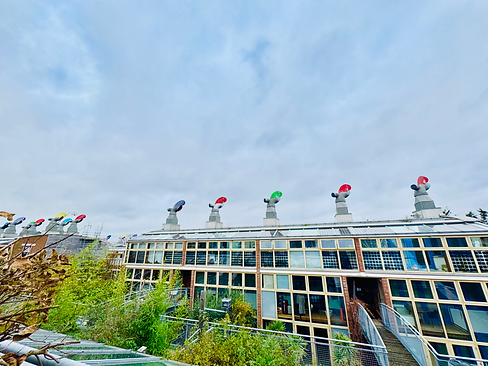
Lonnie: Well, if you saw this as you walked around with Jamie earlier, we have south-facing terraces, green roofs, and buildings made from reclaimed and locally sources materials that lower the carbon footprint naturally. Our wind cowls, of course, define our community in many ways. They are pretty iconic, given their striking rainbow colors and rotation. We use these for passive ventilation using wind and convection. Heat exchangers reuse the warmth of the outgoing stale air to warm up the incoming fresh air, minimizing heat loss and eliminating pollutants. Our waste management is based on a simply reuse, reduce principle, where our consumption is automatically reduced because of space limitations and waste is sorted into paper, plastic, glass. Our organic waste is actually composted onsite. We use that as a fertilizer for our gardens here.
Rhea: How does your green space work?
Jamie: Well, we have integrated green spaces all around us, including rooftops and this helps us promote biodiversity. if you see the flat and terraced sedum roof design, it is mostly in the north facing areas, and allows tenants to grow their own plants and harvest rainwater effectively. The unique curves and terraces are designed in an ingenious way to allow sunlight to stream into the adjacent buildings and hit the solar panels on their roofs and windows. Our solar panels are on both the roof and windows, if you observe closely. We also encourage personal food production, which might also serve as an additional source of income for several elderly people and larger families living here. The stressed concrete retains residual heat to make it more comfortable, and you can feel the temperature change as you walk in and out of our homes. It's really comfortable inside, as you can probably tell right now in this room, despite the freezing cold outside. .
Rhea: Are you conscious about the cowls and green spaces?
Jamie and Lonnie: Not really, we hardly pay attention, except if there are issues or visitors, and it certainly makes our lives better. The green spaces help a lot and are multi-functional for our lives, and we also use the open spaces or terraces for community meet ups or parties etc.
Rhea: Do you think all of London might transform to sustainable communities like BedZed some day?
Lonnie: Well, if you've been to One Brighton, you'll know that it was built as the next step to BedZed, taking all the positive design and living aspects and improving on certain issues we have here. Culture shift hasn't entirely happened yet, since not everyone can accept living in such a community yet. Sustainability comes with its own price, and so most people prefer the regular communities.


Kamikatsu Village. -Interview
The concept of carrying your personal trash bag and bridging it back to your home or hotel caught my attention while traveling in Japan. In Kamikatsu, I stayed at hotel Why, that had upcycled materials in rooms and experienced sustainable living first-hand. Almost 20 years into the intensive recycling, reuse and upcycle focus here, the famous zero-waste life here does not mean zero garbage, but rather diverting waste from landfill and incineration, which in turn reduces both carbon footprint and greenhouse gas emissions. The 1,500+ person village is nestled in a gorgeous green countryside on the island of Shikoku. Waste here is painstakingly and deliberately sorted into 45 categories, reusable stuff is on sale at "Kuru Kuru", and the Zero Waste center has a shabby-chic atmosphere, with over 500 windows frames that were donated by the residents of the town. Broken appliances, electronics, and furnishings are meticulously fixed, repurposed or salvaged for other purposes. The community has a vibrant vibe and a sense of strong purpose, since sustainable living has attracted residents from all over the world. Everyone here uses reusable containers to buy essentials that are sold in bulk. The town does not have bling or reek of materialism! Instead, it is filled with residents who are engaged totally, understand issues and work together to identify workarounds. For example, when illegal trashing became a pressing issue, they eliminated fees for trash brought to the Zero Waste Center, and cameras that report any suspicious activity on trails and pathways.
This visit to Kamikatsu radically transformed my own perspective on consumption and waste disposal. Kamikatsu has successfully diverted over 80% of all its waste by composting, reuse and recycling. This small town has inspired at least 4 other communities, including Oki Town to declare zero-waste movements. Sadly, this tight-knit, rural eco-lifestyle might not be feasible in all areas of Japan, especially in urban cities. However, what If urban areas reduced food waste, and refused packaging altogether ? Wouldn't that drastically reduce the burden on "downstream" waste management facilities?
Eco Truly Park, Peru
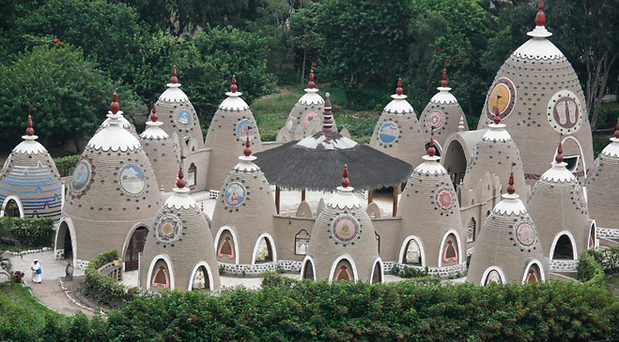
Nestled in between impressive sand dunes and the Pacific sea, Eco Truly Park in Peru captivates you as you walk in, with eye-catching, cute, vernacular cone-shaped homes. What strikes you as you look closer is that these homes are made of mud, bamboo, recycled glass, stone, wood and other natural, locally sourced materials. This community, just an hour away from Lima, seems to blend in effortlessly into the surrounding environment. The colorful Indian motif decorations enhance the simple beauty in this village. Heavy emphasis is placed on frugal living, with rustic and practical beds, room temperature water for washing etc. Mindfulness is integrated into the lifestyle here, with yoga, meditation, and reiki. There is practical garden that is used to grow produce, and the food, strictly vegetarian. is mostly cooked in solar cookers. There is no refrigeration, ensuite bathrooms or alcohol here. Residents here adhere to principles of non-violence, self sufficiency, tolerance, compassion, patience, and elevated thinking. My visit to this town and interviews here left me with a lasting impression about the genuine peace that only a transformative , conscious, simple, non-materialistic, and sustainable lifestyle can provide. Da Vinci's quote, "Simplicity is the ultimate sophistication" fits right into this town's approach. In my opinion, all of us need to consciously slow down, breather, ponder on experiences and relationships instead of constantly racing towards a complex lifestyle.